Vintage/Date Harvested: 2024
Appellation: North Dakota, Cavalier County (Langdon)
Grower: MacT Farm
12 % alc/vol
Rhubarb (Rheum × hybridum; derived in part from ancestral species including R. rhabarbarum and R. rhaponticum) is a hardy, cool-climate perennial valued for its exceptional winter tolerance, vigorous spring emergence, and distinctive acid profile (Linnaeus, 1753). Cultivated forms likely arose from the hybridization and selection of several Asian and Eurasian Rheum species that were historically used for culinary and medicinal purposes (Foust, 2014; Kolodziejczyk-Czepas and Liudvytska, 2021; Libert and Englund, 1989; Marshall, 1988). In modern horticulture, rhubarb is grown primarily for its thick, fleshy leaf petioles, which range from green to deep crimson and contribute bright color, sharp acidity, and a characteristic tart flavor. In northern prairie regions such as North Dakota, rhubarb has become an iconic specialty crop because it reliably thrives under harsh winters, produces early in the growing season, and expresses a strong regional identity tied to resilience, heritage gardens, and value-added local food production.
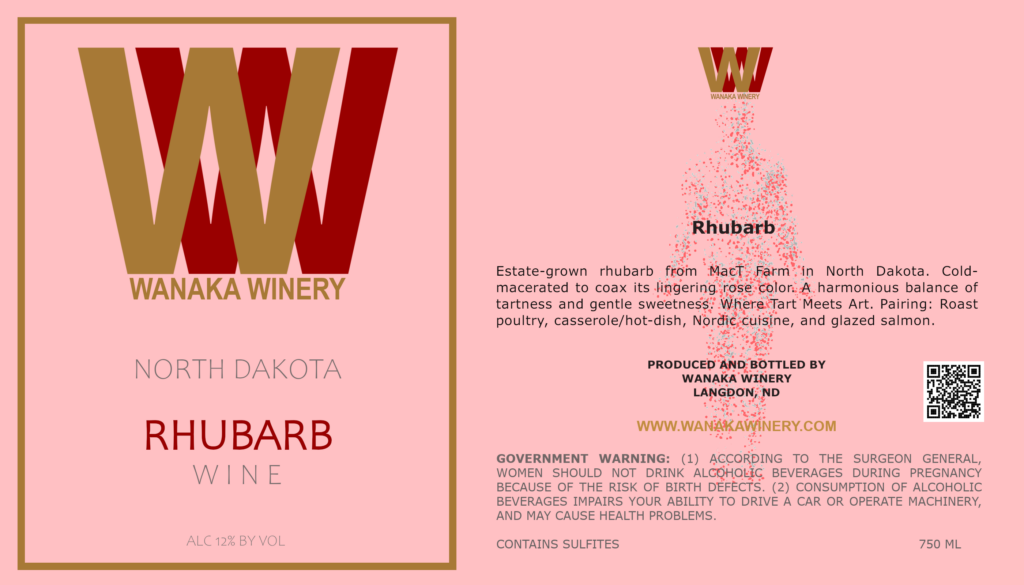
Estate-grown rhubarb from MacT Farm in North Dakota. Cold-macerated to coax its lingering rose color.
Characteristic fresh rhubarb flavors that are lightly floral. Light pink salmon color. A harmonious balance of tartness and gentle sweetness.
Where Tart Meets Art.
Pair with: Roast poultry, baked ham, casserole/hot-dish, Nordic cuisine, and glazed salmon.
Winemaking procedure
The harvested petioles are flash-frozen to enable year-round small-batch production. Freezing promotes improved juice yields by breaking the cellular structures within the stalk. The stalks are then gently pressed and slowly, cool-fermented using a pure yeast strain. The wine is then coarse-filtered directly off the lees, followed by fine filtering. Sweetness is balanced with acidity, and the finished wine is bottled soon after fermentation to preserve the fresh, floral essence. This wine is a consistent medal winner.
Chemistry Profile
| Stage | Alc. (% v/v) | °Brix | pH | TA (g/L as citric) | Malic (g/L) | RS (g/L) |
| Harvest | — | 1.8 | 2.08 | 20.6 | 15.0 | — |
| Bottling | 11.6 | 1.0 | 3.62 | 5.83 | 4.77 | 84.1 |
Availability
| Price | $20 |
| Cases | 12 |
| Released | 2026 Winter |
Packaging
| Bottle: | 750 mL 30W65F Clear Flint Bordeaux Wine Bottles |
| Closure: | Amorim Xpür: 44×24 mm |
| Capsule: | Material: PVC Heat Shrink Sleeves; Matte Black; 33 mm Ø x 60 mm H |
| Label: | Northern Plains Label: BOPP, matte varnish; 178 mm L x 102 mm H (4″x7″) |
References
Foust, C.M., 2014. Rhubarb: the wondrous drug. Princeton Univ Press, Place of publication not identified.
Kolodziejczyk-Czepas, J., Liudvytska, O., 2021. Rheum rhaponticum and Rheum rhabarbarum: a review of phytochemistry, biological activities and therapeutic potential. Phytochem. Rev. 20, 589–607. https://doi.org/10.1007/s11101-020-09715-3
Libert, B., Englund, R., 1989. Present Distribution and Ecology of Rheum rhaponticum (Polygonaceae). Willdenowia 19, 91–98.
Linnaeus, C., 1753. Species plantarum : exhibentes plantas rite cognitas ad genera relatas, cum diferentiis specificis, nominibus trivialibus, synonymis selectis, locis natalibus, secundum systema sexuale digestas. Junk, Berlin. https://doi.org/10.5962/bhl.title.37656
Marshall, D., 1988. A bibliography of rhubarb and rheum species. [Washington, D.C.] : U. S. Dept. of Agriculture, National Agricultural Library, Agricultural Research Service.