Vintage/Date Harvested: 2023
Appellation: Montana, Ravalli County (Corvallis)
Grower: Montana State University, Western Ag Research Center
12 % alc/vol
Haskap (Lonicera caerulea L.), also known as honeyberry or blue honeysuckle, is a cold-hardy, disease-tolerant berry species in the Caprifoliaceae family that is exceptionally well adapted to northern production systems. Native across the cool temperate and boreal regions of North America, Europe, and Asia, it is prized for its very high anthocyanin and total phenolic concentrations, which exceed those of many commonly consumed berries, including blueberries, and contribute to its characteristic deep indigo-blue color, strong antioxidant capacity, and vivid tartness (Rupasinghe et al., 2018, 2015). Modern domestication and cultivar development emerged from Japanese (Hokkaido), Russian, and Canadian germplasm, with major breeding advances led by Dr. Maxine Thompson at Oregon State University, who introduced Japanese and Russian material into North American breeding, and Dr. Bob Bors at the University of Saskatchewan, whose program developed many of the commercially important cultivars now used in northern regions, including the Boreal and Indigo series (Bors and Thomson, 2009).
Haskap typically ripens two to three weeks before strawberries, making it one of the earliest fruit crops available in cold climates. Despite this agronomic advantage, the fruit remains relatively uncommon in fresh retail markets because of its thin skin, soft texture, and high juice bleed, which reduce postharvest durability and shipping performance. Consumer awareness remains comparatively low, even though the sensory profile of well-selected cultivars is frequently described as a compelling blend of blueberry, raspberry, blackberry, and black currant characters, depending on genotype and maturity (Bors, 2010).
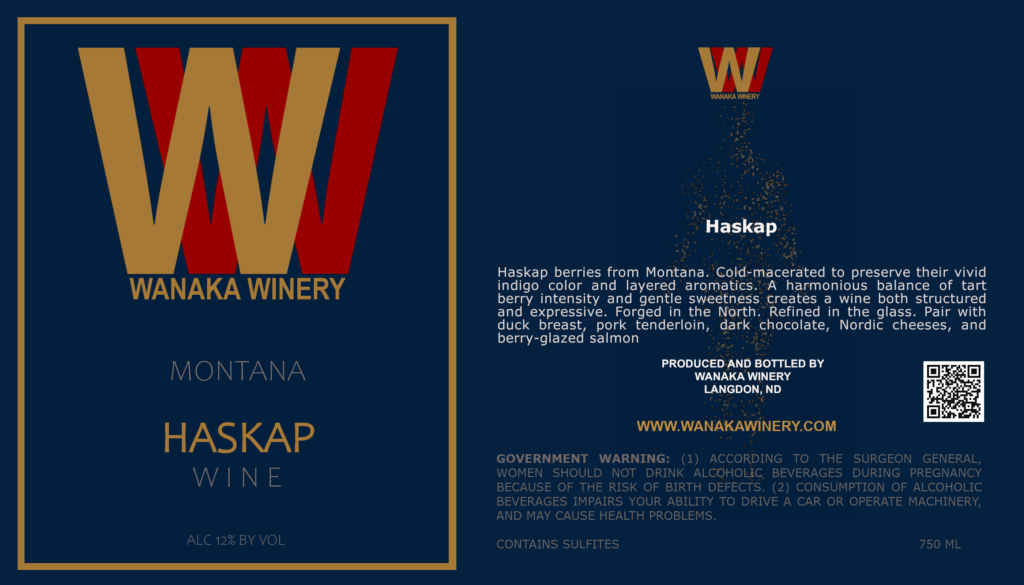
This wine is made from equal parts of 12 varieties of Haskap berries (Aurora, Boreal Beauty, Boreal Blizzard, Chito, HoneyBee, Indigo Gem, Kaido, Kapu, Kawai, Keiko, Taka, Tana) grown in western Montana, cold-macerated to preserve their vivid indigo color and layered aromatics.
A harmonious balance of tart berry intensity and gentle sweetness yields a wine both structured and expressive.
Forged in the North. Refined in the glass.
Pair with: duck breast, pork tenderloin, dark chocolate, Nordic cheeses, and berry-glazed salmon.
Chemistry Profile
| Stage | Alc. (% v/v) | °Brix | pH | TA (g/L as citric) | Malic (g/L) | RS (g/L) |
| Harvest | — | 16.7 | 3.09 | 23.7 | 13.4 | — |
| Bottling | 12.6 | 1.0 | 3.23 | 7.87 | 1.65 | 28.7 |
Availability
| Price | $28 |
| Cases | 30 |
| Released | 2026 April 18 |
Packaging
| Bottle: | 750 mL 30W65F Clear Flint Bordeaux Wine Bottles |
| Closure: | Amorim Xpür: 44×24 mm |
| Capsule: | Material: PVC Heat Shrink Sleeves; Matte Black; 33 mm Ø x 60 mm H |
| Label: | Northern Plains Label: BOPP, matte varnish; 178 mm L x 102 mm H (4″x7″) |
References
Bors, B., 2010. Haskap: The Shape of Things to Come? [WWW Document]. Univ. Sask. Fruit Program. URL https://research-groups.usask.ca/fruit/documents/haskap/HaskapShapeToCome.pdf (accessed 4.12.26).
Bors, B., Thomson, J., 2009. Haskap Breeding & Production Final report ADF# ADF Grant 2006-0140 60.
Rupasinghe, H.P.V., Arumuggam, N., Amararathna, M., De Silva, A.B.K.H., 2018. The potential health benefits of haskap (Lonicera caerulea L.): Role of cyanidin-3-O-glucoside. J. Funct. Foods 44, 24–39. https://doi.org/10.1016/j.jff.2018.02.023
Rupasinghe, H.P.V., Boehm, M.M.A., Sekhon-Loodu, S., Parmar, I., Bors, B., Jamieson, A.R., 2015. Anti-Inflammatory Activity of Haskap Cultivars is Polyphenols-Dependent. Biomolecules 5, 1079–1098. https://doi.org/10.3390/biom5021079